One of the most persistent myths in business is that success requires a completely original product.
Entrepreneurs are constantly told to invent something new, enter an uncontested market, or find a product nobody else is selling. Yet some of the strongest retailers in America have built remarkable businesses by selling products that customers can easily purchase somewhere else.
Abt Electronics sells televisions, refrigerators, and appliances available at Best Buy, Home Depot, and countless online stores. B&H Photo sells cameras and computers found on Amazon. Sweetwater sells guitars, microphones, and audio equipment carried by major music retailers. AJ Madison sells many of the same appliance brands offered by national chains.
Their products are not unique.
The way they sell them is.
That distinction matters to me because I work in e-commerce for Atlantic Restaurant & Supermarket Equipment. We sell commercial refrigerators, cooking equipment, walk-in coolers, display cases, and other products that are also sold by large national competitors. Looking at these companies has reinforced an important lesson: you do not always need an exclusive product to build an exceptional business. Sometimes you need to create an experience your competitors cannot easily reproduce.
Abt Electronics: Turn the Store Into the Brand
Abt Electronics began as a small Chicago radio shop in 1936. Today, it describes itself as America’s largest independently owned, single-location retailer of electronics, appliances, and home goods. Its Glenview campus is anchored by a showroom of more than 100,000 square feet and serves customers across a roughly 100-mile local radius while also operating a successful national e-commerce business. Abt Electronics
Abt sells many of the same products as enormous national chains, so its success cannot come from the merchandise alone. Its differentiation is built around the experience surrounding that merchandise: a massive physical showroom, knowledgeable employees, customer service, delivery capabilities, and decades of trust.
The showroom is particularly important. It is not treated simply as an address where customers can buy something. It is part of the product.
Customers can compare appliances, speak with specialists, and see what they are purchasing before making an expensive decision. That physical experience also strengthens Abt’s online business. Even customers who never visit the store can see that a real operation, real inventory, and real people stand behind the website.
Atlantic has a similar opportunity.
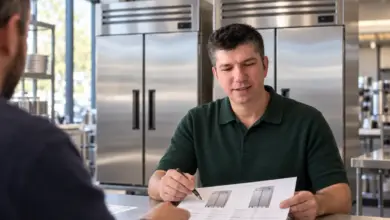
Our 50,000-square-foot Kearny showroom should not be reduced to a line in the footer of our website. It is one of our most valuable competitive advantages. An online-only retailer can display thousands of product pages, but it cannot invite a restaurant owner to walk through rows of commercial equipment, compare new and used options, and speak face-to-face with someone who understands the project.
The lesson from Abt is simple: make the physical business visible online.
B&H Photo: Expertise Can Become a Product
B&H started as a small New York City camera store in 1973 and grew into one of the largest independent retailers of its kind in the United States. Its Manhattan SuperStore remains central to the brand, even though B&H now serves customers far beyond New York. B&H Photo
People can purchase a camera almost anywhere. They choose B&H because the company has built a reputation for understanding what it sells.
Its website does more than list specifications. B&H publishes buying guides, product demonstrations, reviews, tutorials, and detailed comparisons. Customers can speak with specialists, request a callback, order online, pick up at the store, and shop for used equipment.
B&H reduces a problem every buyer faces when purchasing technical products: uncertainty.
The customer is not only asking, “Where can I find this camera?” The more important questions are, “Is this the right camera for me? What else do I need? Am I about to make an expensive mistake?”
Commercial restaurant equipment creates the same uncertainty on a much larger scale. Choosing the wrong refrigerator, refrigeration system, walk-in dimensions, or electrical configuration can cost a business thousands of dollars.
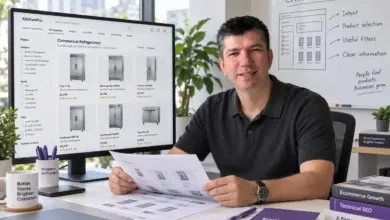
Atlantic should therefore treat expertise as something we sell alongside the equipment. Our content should answer the questions customers are afraid to ask. Our product pages should explain differences clearly. Our salespeople should appear in videos, comparisons, and project walkthroughs.
When information is available everywhere, trusted interpretation becomes valuable.
Sweetwater: Make the Salesperson Part of the Value
Sweetwater may offer the clearest example of turning human service into a scalable competitive advantage.
The company sells music instruments and professional audio equipment that can be found through many other retailers. Its signature difference is the Sales Engineer: a highly trained specialist who develops an ongoing relationship with the customer and helps select the right equipment for the customer’s goals and budget.
Sweetwater even created an intensive 13-week training program for these specialists. The title “Sales Engineer” is deliberate: it tells customers that the person helping them is more than a typical sales associate. Sweetwater Sales Engineers
That changes the meaning of a sales call.
“Leave your number and a salesperson will contact you” sounds like an invitation to be sold to. “Speak with an equipment specialist who will help you choose the right system” sounds like a valuable service.
This is directly applicable to Atlantic.
A customer planning a walk-in cooler does not simply need a price. They may need help with dimensions, box layout, refrigeration capacity, flooring, indoor versus outdoor configuration, delivery, and financing. The salesperson should be positioned as the person who removes that complexity.
One call. The right equipment. No guesswork.
Sweetwater proves that personal service does not have to disappear as e-commerce grows. When designed correctly, it can become the reason e-commerce grows.
AJ Madison: Connect Online Convenience With Physical Confidence
AJ Madison demonstrates another version of the same strategy. Founded in 2001, the appliance retailer has built a large online catalog while also investing in physical showrooms and design centers. Its Brooklyn flagship showroom covers approximately 16,000 square feet, and the company presents appointments, expert assistance, product selection, and post-purchase service as part of the experience. AJ Madison Showrooms
The customer journey does not have to be purely online or purely offline.
A customer might discover a product through Google, compare models on the website, see remarketing ads, schedule an appointment, visit the showroom, speak with an expert, and complete the purchase by phone. Every step supports the others.
This is the model I believe Atlantic should pursue.
Meta and Google advertising should not be viewed only as tools for generating immediate online transactions. They can introduce Atlantic to local business owners, bring qualified visitors to the website, build remarketing audiences, create showroom visits, and initiate conversations that later become substantial sales.
For an expensive and complicated purchase, the most valuable conversion may not be an online checkout. It may be the beginning of a trusted relationship.
The Real Competitive Advantage
Abt, B&H, Sweetwater, and AJ Madison all sell products that their competitors can also sell. Their advantage is the system built around those products.
They combine selection with guidance, online convenience with human access, and competitive pricing with confidence. Their physical locations establish credibility. Their content establishes authority. Their people reduce risk. Their customer experience gives buyers a reason to return.
That is the lesson I want to apply at Atlantic.
We should not attempt to become a smaller copy of a giant online restaurant-equipment retailer. We should build around the advantages a national, online-only competitor cannot easily reproduce: a large local showroom, visible inventory, experienced specialists, new and used options, regional delivery, custom projects, and real relationships with restaurant and supermarket owners.
The winning position is not simply, “We sell restaurant equipment too.”
It is:
Online prices. Local expertise. A real showroom behind every sale.
You do not always win by selling something nobody else has.
Sometimes you win by helping people buy what everyone else sells, more confidently, more intelligently, and with far less risk.