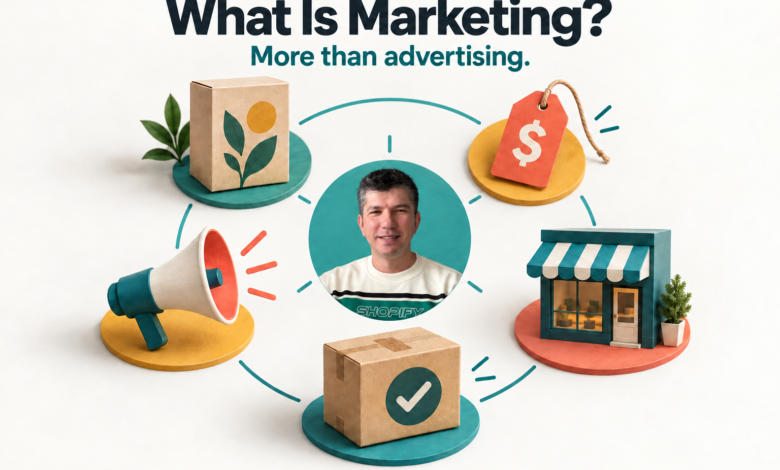
Marketing is the work of understanding a market, choosing whom to serve, shaping an offer people value, and helping those people discover, evaluate, buy, and continue benefiting from it.
Advertising is part of that work. So are product positioning, pricing, distribution, customer education, and the experience surrounding a purchase.
For an e-commerce business, marketing does not begin when an ad goes live or end when an order comes in. It starts with the question of why someone should choose the business at all. It continues through the product page, the delivery promise, the support conversation, and the reasons a customer might return.
That is how I approach marketing: not as a collection of platforms to keep busy, but as a connected set of decisions about customers, value, and growth.
What Marketing Actually Does
My definition above is a practical working definition, not a quotation. It is consistent with the American Marketing Association’s broader treatment of marketing as creating, communicating, delivering, and exchanging offerings of value. American Marketing Association: Definition of Marketing
In practice, I divide the work into five responsibilities:
- Understand demand: learn what people need, what they currently use, and what makes them hesitate.
- Choose a market: decide which customers the business can serve well, rather than trying to appeal to everyone.
- Shape the offer: connect the product, price, service, and buying conditions to that market.
- Create and capture demand: help people recognize a need, discover the business, and evaluate its offer.
- Build a durable relationship: support a good experience and give customers appropriate reasons to return or recommend the business.
Marketing does not control every department involved. It does need to work with them. A campaign promising effortless delivery depends on operations being able to deliver that experience.
Marketing vs. Advertising, Sales, and Branding
These terms overlap, but treating them as interchangeable creates confusion about what needs fixing.
| Discipline | Main question | E-commerce example |
|---|---|---|
| Marketing | Whom should we serve, with what value, and how will we reach them? | Choosing a customer segment and designing an appropriate offer |
| Advertising | Which message should we pay to distribute, and where? | Running a paid campaign for a specific product range |
| Sales | How do we help a qualified buyer complete the purchase? | Clarifying project requirements and preparing a quote |
| Branding | What should people recognize, expect, and remember about us? | Aligning positioning, identity, language, and experience |
A business can run competent advertising around an unclear offer. It can have a memorable logo and an unreliable purchase experience. It can generate inquiries that its sales team cannot turn into suitable orders.
Those are different problems. Increasing the ad budget is not a universal solution.
In my Supermarket World branding work, for example, the decisions went beyond visual identity. The guidelines distinguished a straightforward equipment purchase from a project requiring a quote. The marketing question was how to make the next step fit the customer’s task.
Start with the Offer: The Four Ps of Marketing
The four Ps are product, price, place, and promotion. They remain a useful way to check whether the business decisions behind a campaign fit together. American Marketing Association: The Four Ps
Product: What problem does the offering solve, and what experience comes with it? Think about configuration, service, and support as well as the physical item.
Price: What does the buyer pay, and what makes that price reasonable? Discounts are only one decision; bundles, terms, and the cost of fulfilling the promise matter too.
Place: Where and how can someone evaluate and obtain the offering? A website, marketplace, showroom, or distributor creates different opportunities and constraints.
Promotion: How will the right people discover and understand it? Advertising, content, events, and personal recommendations can play different roles.
I use this framework as a diagnostic, not a rigid departmental chart. If a product is difficult to obtain or the offer is poorly matched to its audience, more promotional activity may simply expose the weakness faster.
Strategy Comes Before Channels
"We need to post more" describes an activity. "We need to win buyers who value technical guidance over the lowest initial price" starts to describe a strategic choice.
Before selecting channels, I would write down:
- The customer: a specific group with a recognizable situation or need.
- The problem: what they are trying to accomplish and what makes it difficult.
- The alternatives: what they might buy, use, or do instead, including doing nothing.
- The promise: the relevant value the business can actually deliver.
- The proof: the facts, demonstrations, experience, or customer evidence supporting that promise.
- The economics: what acquiring and serving that customer can sustainably cost.
Consider a fictional equipment supplier serving independent grocery stores. Its strategy might emphasize selection guidance and clearly scoped delivery rather than claiming to be the cheapest supplier in every category.
That choice should affect its product information, sales process, content, and advertising. If the strategy exists only in a presentation, it is not yet guiding the customer experience.
This is also why building a memorable e-commerce brand requires more than selecting colors. The business needs a meaningful reason to be chosen and a consistent way to express it.
Marketing Channels and Approaches: 16 Useful Options
I do not find a strict digital-versus-traditional split especially helpful when planning an e-commerce business. A showroom visit can lead to an online order. A useful article can lead to a phone conversation. An event can produce both customer insight and future content.
The options below are not a popularity ranking or mutually exclusive categories. Some are distribution channels, some are ways of building trust, and AI is an enabling capability. They often work together.
1. Paid Advertising
Paid advertising purchases access to an audience through formats such as search ads, social ads, video, display placements, or offline media.
It can help test a message or reach potential buyers, but paying for visibility does not create product-market fit. I would evaluate the offer, landing page, targeting, and contribution after costs, not just clicks or platform-reported revenue.
2. Search Marketing: SEO and Paid Search
Search connects a business with questions people are already expressing. SEO works on visibility in unpaid results; paid search buys advertising placements. In this article, I use search marketing as the umbrella and paid search when I mean search advertising specifically.
Paying for Google ads does not buy higher organic rankings. Display advertising is also not the same as search advertising simply because both can be managed through an advertising platform. Google: SEO vs. PPC
For a merchant, the useful question is which searches indicate a need the business can genuinely satisfy.
3. Content Marketing
Content marketing uses useful information or experiences to attract and help an audience. That can include buying guides, demonstrations, comparisons, articles, or maintenance instructions.
I would choose topics around customer decisions, not a requirement to publish a certain number of posts. A relevant guide with a clear route to suitable products is more purposeful than a large library of loosely related articles.
4. Social Media Marketing
Social platforms can support discovery, conversation, product demonstration, and customer feedback. Organic publishing and paid distribution are different mechanisms, even when they appear in the same feed.
Platform choice should reflect the audience and the kind of material the team can produce consistently. Attention from people who will never need the offer is not automatically a useful business outcome.
5. Email and Lifecycle Marketing
Email can support welcome sequences, product education, replenishment, and re-engagement. Lifecycle marketing is the broader practice of matching communication to the customer’s relationship with the business.
A first-time prospect and an established customer should not always receive the same message. Use appropriate permission, accurate customer data, and relevant timing. A one-time equipment purchase calls for a different follow-up than a consumable product.
6. Influencer and Creator Marketing
Creators can introduce a product through an established audience and a recognizable perspective. The value may come from distribution, demonstration, creative production, or a combination of these.
I would assess audience relevance, content quality, usage rights, and the terms of the collaboration before focusing on follower count. A credible demonstration requires the creator to understand the actual product, not repeat unsupported claims.
7. Affiliate Marketing
Affiliate marketing compensates partners for defined outcomes, commonly a tracked sale or lead. It can overlap with creators, publishers, comparison sites, and other partners.
Performance-based payment is not the same as risk-free growth. Commissions, discounts, returns, fraud controls, and attribution all affect whether the program adds profitable business rather than taking credit for demand that already existed.
8. Founder-Led Marketing
Founder-led marketing uses the founder’s perspective to explain why the company exists and how it makes decisions.
The strongest material is often specific: why a product was changed, what a customer problem revealed, or what trade-off the business made. The founder does not need to become a full-time personality. The objective is to make relevant judgment visible, not document every personal moment.
9. Expertise and Authority Building
Authority develops when an audience has reasons to trust someone’s knowledge. Useful explanations, documented projects, original analysis, and honest answers can contribute to that trust.
Calling a business an industry leader does not establish expertise. Showing how it evaluates a difficult choice is more useful. This is especially relevant in B2B marketing, where the buyer may need to justify a decision to several people.
10. Community Marketing
A community creates ongoing interaction around a shared interest, challenge, or professional context. It is more than a mailing list with a different name.
The practical question is why members would return when they are not ready to buy. Peer advice, useful introductions, and shared learning can provide that reason. Moderation and member value need an owner; a group that exists only to receive promotions has little reason to remain active.
11. Word of Mouth and Referral Marketing
Word of mouth happens when people share an experience. A referral program deliberately supports introductions, sometimes with an incentive.
Neither removes the need for a worthwhile product and experience. I would make recommendations easy and distinguish genuine customer feedback from incentivized activity. The number of invitations sent matters less than the quality of the customers and relationships they produce.
12. Event and Experiential Marketing
Events include demonstrations, workshops, trade shows, webinars, and pop-ups. They can be useful when people need to experience a product or ask detailed questions.
Plan the next step before the event: a useful follow-up, a consultation, a trial, or a purchase. Attendance alone does not show whether the event helped the business or the participants.
13. Local Marketing
Local marketing focuses on customers whose needs connect to a specific geography. That can matter for stores, showrooms, local delivery, pickup, and location-dependent services.
An online business with a real regional advantage should explain it accurately. Useful local information includes where customers can visit, what is available there, and which delivery or service arrangements need confirmation. Creating pages for places the business cannot meaningfully serve is not a substitute for local relevance.
14. Offline Marketing
Print, direct mail, signage, packaging, and other physical materials can support an e-commerce business when they reach the right audience with a relevant next action.
I would judge a physical touchpoint by its role, not by whether it looks less modern than a digital channel. A clear product insert or showroom handout can answer an important question. It still has production and distribution costs that belong in the evaluation.
15. Partnerships and Co-Marketing
Complementary businesses can collaborate on education, events, distribution, or a shared offer. Unlike an affiliate arrangement, the relationship does not have to revolve around a commission.
The useful test is whether the customer benefits from the combination. Responsibilities, follow-up, permissions, and lead handling should be agreed before launching a joint campaign, not left to assumptions afterward.
16. AI-Assisted Marketing
AI can support research, drafting, analysis, and the organization of product information. It is not a separate audience or distribution channel, and automation does not always require AI.
I would use it where the inputs are reliable and the output can be reviewed. My guide to improving product pages with AI explains that distinction: better information matters more than producing a greater volume of confident-sounding copy.
Where Do Guerrilla, Nostalgia, and Reposting Fit?
These are useful ideas, but I would not treat them as equivalent to a channel such as email or search.
Guerrilla marketing describes an unconventional approach to attracting attention. Its practical costs, disruption, and reputational risks still need consideration; unusual does not automatically mean inexpensive or effective.
Nostalgia or retro marketing uses associations with an earlier period. It can inform packaging, advertising, or creative direction when those associations fit the audience and the product. It is not inherently appealing to every generation.
Reposting and content amplification describe how material travels further. Shareable content can help, but reposting is a distribution tactic, not a substitute for an offer or a strategy. Permission and attribution matter when reusing someone else’s material.
Connect the Work Across the Customer Journey
Customers do not always move through a neat funnel. They may discover a product, compare alternatives, leave, ask a colleague, and return through a different channel.
The stages below are a planning aid, not a claim that every purchase follows the same sequence.
| Customer task | Marketing’s job | Possible evidence of progress |
|---|---|---|
| Recognize a need | Make a relevant problem or opportunity understandable | Qualified interest and useful audience feedback |
| Evaluate options | Explain fit, differences, and trade-offs | Relevant product exploration and informed inquiries |
| Make a decision | Reduce avoidable uncertainty and purchasing friction | Completed orders or qualified project progression |
| Use the product | Set expectations and help customers succeed | Fewer avoidable problems and appropriate support outcomes |
| Return or recommend | Give people a worthwhile reason to continue | Repeat contribution, retention, or suitable referrals |
One strong campaign cannot compensate indefinitely for a poor experience elsewhere. An informative ad leading to an unclear product page leaves the decision unfinished.
An Example: Marketing an Equipment Business
Imagine a fictional supplier selling refrigerated displays to independent food retailers. Its challenge is not necessarily a lack of awareness. Buyers may already know they need refrigeration but feel unsure about selecting and receiving the right unit.
A connected plan could include:
- Speak with buyers and sales staff to identify the questions that repeatedly delay decisions.
- Clarify the target store types, equipment range, and actual service boundaries.
- Improve product pages with verified dimensions, utilities, inclusions, and delivery requirements.
- Publish a buying guide that helps readers understand the relevant choices.
- Test paid search against appropriate queries and landing pages.
- Use demonstrations and permissioned project material to show practical expertise.
- Follow up with useful information rather than relying only on discounts.
- Compare qualified inquiries, orders, contribution, and avoidable product-selection problems.
The individual activities support the same customer decision. That is what makes them a marketing system rather than a checklist of unrelated campaigns.
This is a hypothetical plan, not a claim of results from a particular client.
How to Choose What to Do First
I would choose priorities around the current constraint.
- An unclear offer: investigate customer needs and positioning before buying more reach.
- Low relevant awareness: test a focused discovery channel and a clear message.
- Demand that already exists: make the business easier to find and evaluate where buyers are looking.
- Traffic without purchases: inspect audience quality, fit, pricing, product information, and purchase friction.
- Weak repeat business: determine whether repeat purchasing makes sense for the category, then examine experience and follow-up.
For a small team, one deliberate acquisition test and one useful follow-up process may be more manageable than maintaining a presence everywhere. That is a prioritization approach, not a rule that every company should use the same two channels.
Measure Business Outcomes, Not Just Activity
Metrics need definitions before they become useful.
| Metric | What it can tell you | What it does not prove |
|---|---|---|
| Conversion rate | How often a defined audience completes a defined action | Why performance changed |
| Customer acquisition cost | Acquisition spending per new customer, within a stated scope | Whether those customers will be profitable |
| Return on ad spend | Attributed revenue divided by ad spend | Profit or sales caused incrementally by the ads |
| Repeat purchase rate | How often a defined customer cohort orders again within a period | Whether more orders produce worthwhile margin |
| Contribution | What remains after the costs included in your calculation | Net profit unless all relevant costs are included |
For example, $10,000 in attributed revenue from $2,000 in advertising is a 5:1 ROAS. It is not $8,000 of profit: product costs, discounts, fulfillment, fees, returns, and other expenses still matter.
Keep the period, customer cohort, cost scope, and attribution method clear. Avoid adding together the revenue claimed independently by several advertising platforms as if it necessarily represented distinct orders.
I would also separate a recorded touchpoint from a causal conclusion. A customer using a coupon does not, by itself, show they would not have purchased without it. Where possible, use a properly designed experiment; otherwise describe observational results with their limitations.
A Simple Marketing Plan You Can Actually Use
A practical first plan can fit on one page:
- Objective: define the business outcome, not only a publishing target.
- Customer: describe the segment and buying situation.
- Offer: state the relevant value and supporting evidence.
- Priority: identify the biggest current constraint.
- Activity: choose a small set of actions addressing that constraint.
- Resources: assign budget, time, ownership, and operational support.
- Measurement: define the primary outcome and the risks to monitor.
- Review: decide when to evaluate, what to learn, and what would justify a change.
Once those decisions are clear, a content calendar becomes a way to deliver the plan rather than fill empty dates.
The plan should also acknowledge what the business will not do yet. Focus is often a more useful constraint than another platform account.
Common Questions About Marketing
Is marketing the same as selling?
No. Selling helps a buyer complete a transaction; marketing also covers understanding the market, shaping the offer, reaching potential buyers, and supporting the relationship. The two should inform each other.
Can a business market itself without paid advertising?
Yes. Content, relationships, partnerships, local activity, and customer recommendations can contribute. But unpaid distribution does not mean the work has no cost: time, expertise, production, and maintenance still require resources.
What is the best type of marketing for e-commerce?
There is no universal answer. It depends on the product, purchase cycle, audience, margin, competition, and current constraint. Choose a testable approach that fits the business instead of assuming another company’s channel mix will transfer.
Is digital marketing different from marketing?
Digital marketing describes work using digital environments and channels. The underlying decisions about customers, value, positioning, and economics still apply. A business may combine digital and physical touchpoints in the same journey.
Can AI replace a marketing strategy?
AI can assist with inputs and execution, but it does not remove the need to choose a market, validate assumptions, approve promises, and judge business trade-offs. Producing content faster is useful only when the content serves a worthwhile plan.
Marketing Is the Connection Between the Offer and the Customer
The most useful question is not "Which marketing type is most popular?" It is "What does this customer need to understand or experience before choosing us, and can we deliver what we promise?"
Answer that clearly, and channel decisions become easier. Advertising has something meaningful to communicate. Content has a purpose. Sales conversations start with better information. The brand becomes connected to an experience people can recognize.
That is the kind of marketing I want to build: work that helps customers make better decisions and helps a business earn growth it can sustain.