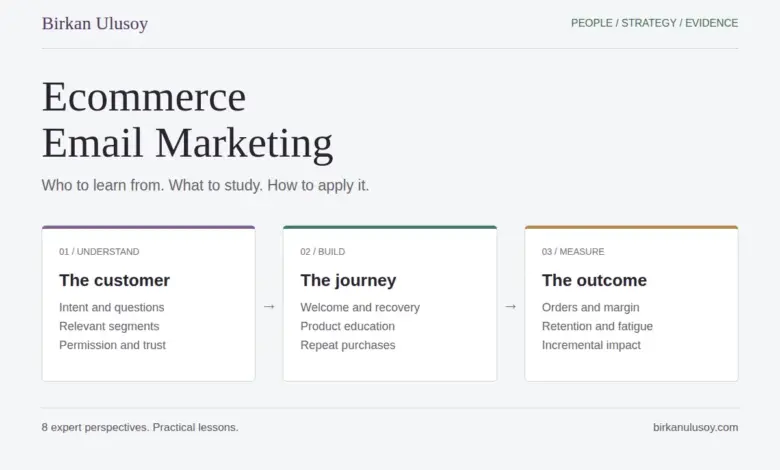
The ecommerce email marketers worth learning from do more than write persuasive subject lines. They help us understand why a customer signs up, what stops a purchase, and what makes someone come back.
When I look at an email program, I start with the buying decision. A restaurant operator considering a commercial refrigerator is not making the same decision as someone replenishing skincare. The price, urgency, questions, and time between purchases are different. Sending both people an identical sequence of reminders and discounts misses the point.
That is why I would build a learning list around different kinds of expertise: customer research, lifecycle strategy, copy, implementation, testing, and measurement. Here are eight people whose published work offers something specific to study, followed by the email system I would build from those lessons.
Research checked September 23, 2026. This is an editorial selection, not a ranking. Linked examples are public work, not projects I worked on. Reported results belong to their original authors, agencies, or platforms and have not been independently audited by me. Practical examples marked as illustrative are my proposed applications, not client results.
What ecommerce email marketing should actually accomplish
Ecommerce email marketing is the use of permission-based campaigns and behavior-triggered messages to help people choose products, complete purchases, use what they bought, and return when another purchase makes sense. A campaign reaches a chosen audience at a planned time. An automated flow responds to an event or condition, such as a subscription, an eligible abandoned checkout, or a completed order.
Neither format is inherently valuable. Value comes from matching the message to a real customer need. A useful size guide can outperform another offer for someone uncertain about fit. Delivery preparation can matter more than a cross-sell for someone waiting for heavy equipment. The commercial objective is to make the next appropriate decision easier, not simply to increase the number of sends.
My test for any email is simple: what does this person need to know or do, why now, and what should happen if they already did it? That last question prevents welcome discounts from reaching existing buyers and promotional reminders from continuing after a purchase.
Who to follow for ecommerce email marketing
I selected these people for the usefulness of their accessible work, the clarity of their methods, and the range of problems they address. I did not use follower counts as a proxy for expertise. Some resources are free articles; others require an email signup or lead to paid training. A published case study is evidence to examine, not a guarantee that an approach will work for your store.
- Kath Pay: testing and commercial outcomes
- Samar Owais: customer journeys and copy
- Andriy Boychuk: lifecycle implementation
- Val Geisler: onboarding and retention
- Chase Dimond: DTC flows and campaign planning
- Jessica Totillo Coster: practical segmentation
- Greg Zakowicz: benchmarks and measurement
- Laura Palladino: campaign audits and creative
Kath Pay
Email strategist, author, and founder of Holistic Email Marketing
Study her work for: choosing the right test, not just the winning subject line.
Kath’s work is particularly useful when a team has plenty of email activity but an unclear definition of success. Her published Cannadips example compares two browse-abandonment approaches: one explicitly acknowledged browsing; the other presented related products more subtly.
The reported result: the subtler version generated more opens and clicks, but the explicit version achieved a 4% order placement rate and a 20% lift over the alternative. That is a relative lift, not an increase of 20 percentage points. The public account does not provide enough raw data for me to independently assess statistical significance.
My takeaway: define the commercial outcome before looking at the dashboard. Otherwise, it is easy to celebrate attention while overlooking purchases.
Illustrative application: for a furniture store, test a message addressing a shopper’s product-selection question against a generic collection reminder. Keep the audience, timing, and offer comparable. Judge the result on orders and net revenue per eligible recipient, while watching complaints and unsubscribes.
Samar Owais
Email conversion strategist and founder of Emails Done Right
Study her work for: understanding the customer before writing the sequence.
Samar works across ecommerce and SaaS, with an emphasis on email strategy and copy. Her published ecommerce bootcamp curriculum maps sequences to the customer journey rather than treating every email as an isolated sales pitch. It is a historical curriculum, not a statement about current course availability.
A concrete study: her Workamajig migration case study reports that 100% of customers migrated on time, with more than 500 personal responses to the first email. This is a software migration outcome, not an ecommerce conversion-rate result. I include it because it demonstrates communication designed around a difficult customer action.
My takeaway: the email’s job may be to remove uncertainty or start a support conversation, not produce an immediate checkout.
Illustrative application: after a buyer requests equipment information, write follow-ups around installation constraints, lead times, and delivery access. Invite a reply when those details are unresolved. Measure qualified conversations and eventual orders instead of assuming that every non-click represents failure.
Andriy Boychuk
Founder and CEO of Flowium
Study his work for: translating lifecycle strategy into functioning automations.
Andriy’s work is useful when the problem is not a shortage of ideas but a disconnected collection of flows. In a sporting-goods case study co-authored with Stripo, he describes Flowium’s work on post-purchase, repeat-purchase, and win-back messaging.
The reported result: over three months, flow revenue increased 75.9% and returning-customer revenue increased 150.7%. These are Flowium’s reported outcomes for an unnamed brand. They are not independently audited incremental revenue, and the public account does not establish how much of the change would have happened without the intervention.
My takeaway: I would study the transitions between purchases, rather than copying the headline percentages or imposing the same win-back interval on every category.
Illustrative application: split a post-purchase experience into first-time and repeat buyers. Someone ordering a first coffee grinder may need setup advice; an experienced customer may need a relevant accessory or maintenance reminder. Confirm that shipment status, refunds, and recent purchases prevent inappropriate messages before activating the flow.
Val Geisler
Strategic retention consultant for ecommerce
Study her work for: welcoming people and understanding why they stay.
Val’s current positioning focuses on the wider retention ecosystem, including the relationship between acquisition quality and customer behavior. Her Dinner Party Strategy, discussed with Privy, provides a memorable way to think about welcome sequences: build a relationship rather than making every interaction an immediate sales demand.
What makes this worth studying: it is a framework for sequencing communication, not a universal conversion promise. I would use it to question whether an onboarding sequence actually helps someone get comfortable with the product and brand.
My takeaway: do not confuse a new subscriber with a new buyer. They may need different welcomes, even if they joined the same list.
Illustrative application: a skincare subscriber could receive help choosing a routine, followed by relevant product evidence. A first-time customer could instead receive usage guidance and expectations about delivery. I would not withhold a promised signup benefit while telling a long brand story, and I would not send a buyer a discount intended only for a first purchase.
Chase Dimond
Co-founder of Structured and ecommerce email educator
Study his work for: building a practical DTC email program.
Chase’s ecommerce email marketing guide covers foundational flows, audience quality, and campaigns. His public material is a useful starting point for understanding how recurring sends and triggered messages fit together.
A result to interpret carefully: his website reports more than $200 million in email-attributable revenue across agency work since 2018. That is an aggregate self-reported attribution claim across clients and time, not one campaign’s result, incremental profit, or a forecast for your store.
My takeaway: I would borrow the discipline of making the core flows work before expanding a complicated campaign calendar. A missing or broken welcome flow is often a more actionable problem than a shortage of clever campaign names.
Illustrative application: diagram the path from form submission to first purchase. Check whether the incentive arrives, whether the email links to the correct product or collection, and whether purchasing removes the subscriber from inappropriate reminders. Test that journey on a phone using an actual test order before spending more to acquire subscribers.
Jessica Totillo Coster
Founder of eCommerce Badassery; ecommerce and email strategist
Study her work for: useful segmentation a small team can maintain.
Jessica’s background combines retail operations and ecommerce. Her email performance article describes an activewear client whose audience broadened beyond pregnant and nursing customers after publicity for leggings. People interested in leggings did not automatically need nursing sports bras.
The useful evidence: this is a concrete relevance problem, not a quantified lift. The article does not attach a controlled revenue result to that particular segmentation example, so I would not invent one.
My takeaway: a segment earns its place when it changes what you say, show, or offer. More segments do not automatically mean better marketing.
Illustrative application: an equipment supplier might ask subscribers whether they are opening a store, replacing a failed unit, or expanding an existing operation. If that answer changes the guidance and product selection, it is useful. If all three groups receive the same message, collecting the field adds friction without improving the experience. Start with one distinction the team can reliably maintain.
Greg Zakowicz
Ecommerce marketing strategist, researcher, and educator
Study his work for: turning benchmarks into better questions.
Greg’s published research and commentary are useful for examining the relationship between campaigns, automation, and customer behavior. His work includes commentary in Omnisend’s 2025 ecommerce marketing report, which analyzes 2024 performance. This is historical platform research, not a claim about his current employer.
The reported finding: welcome, abandoned-cart, and browse-abandonment messages together accounted for 87% of automated orders in that report. That does not mean they generated 87% of all store orders or that the same distribution should be your target.
My takeaway: automation deserves attention, but customers receiving triggered messages often already have stronger purchase intent. Comparing their conversion rate directly with an entire newsletter audience does not establish causation.
Illustrative application: use the benchmark to inspect missing flows, then compare your own comparable cohorts over time. Record audience eligibility, product category, attribution window, and season. A store selling durable machinery should not expect the repeat-purchase rhythm of a consumables brand.
Laura Palladino
Email and content educator featured in Smart Marketer’s BOOM! training
Study her work for: reviewing a complete campaign rather than collecting isolated screenshots.
In Smart Marketer’s BOOM! email audit resource, Laura reviews six campaigns containing more than 50 emails from the brand’s 2020 holiday promotion. The resource discusses content and sales messaging, audience segmentation, and campaign fatigue. Access requires signup.
What the example demonstrates: a substantial body of campaign work to inspect. The page’s broader BOOM! business-revenue claims are not the revenue generated by those emails, and I would not attribute the company’s total sales to Laura or to this audit.
My takeaway: review the sequence as the customer experiences it. A strong individual email can still belong to an exhausting campaign.
Illustrative application: place a month’s messages in chronological order for one audience. Mark each as education, product guidance, promotion, or service. Look for repeated promises, conflicting offers, and too many messages after a purchase. Keep the exercise focused on the actual experience, not an arbitrary quota for content versus promotion.
The ecommerce email flows I would prioritize
The practical value of following experts is the change you make afterward. I would start with a small, dependable lifecycle program rather than launch every available automation. Here is my working order; actual priority depends on list size, traffic, product economics, and the biggest gap in the customer journey.
| Flow | Customer need | First improvement to test | Guardrail |
|---|---|---|---|
| Welcome | Understand the promise and choose a next step | Product-selection guidance after delivering the signup benefit | Separate prospects from existing customers |
| Checkout recovery | Resolve the reason an order stopped | Delivery or compatibility reassurance instead of an immediate coupon | Stop after purchase; check marketing eligibility |
| Post-purchase | Use the product successfully | Setup and care guidance timed to fulfillment | Keep service notifications separate from promotional pressure |
| Replenishment or cross-sell | Get something genuinely relevant | Timing based on the product and observed buying cycle | Exclude refunded orders and incompatible products |
| Win-back | Reconsider when there is a good reason | A relevant development or reminder, not automatic discounting | Respect inactivity, consent, and suppression rules |
My high-consideration example: for a commercial refrigerator, I would test an email that helps the buyer confirm dimensions, electrical requirements, delivery access, and the next step for unresolved questions. A useful destination could be a complete product page or a human reply, not necessarily an immediate checkout.
Where manufacturer MAP policies constrain advertised pricing, that work becomes especially important. I would not assume every product can be promoted with a larger coupon. The message can compete on clarity, selection support, and reliable service. That connects to the argument in Same Product Better People: selling the same products does not require providing the same buying experience.
A campaign should also have a credible place to send the reader. Link to a useful comparison, installation guide, or relevant product page rather than the homepage by default. My ecommerce content marketing guide explains how to build the underlying material that makes those emails worth opening.
How I would measure ecommerce email marketing results
Before adopting a success story, I want to know what the number actually represents. Email-attributed revenue, total store revenue, and incremental profit answer different questions. They should not be used interchangeably.
1. Start with comparable definitions
Record the reporting period, audience, attribution window, and conversion event. A click-to-purchase rate uses clickers as its denominator; an order rate per delivered recipient uses recipients. Changing the denominator can make two very different programs appear comparable.
For a campaign test, I would record orders and net revenue per recipient, discount costs, unsubscribes, and complaints. For lifecycle performance, I would also examine time to a second order and repeat-purchase rates within comparable customer cohorts. Returns and cancellations matter; a large checkout total is not the same as a profitable sale.
2. Treat opens as a limited signal
Apple Mail Privacy Protection can preload tracking images, so a recorded open does not always mean a person read the message. Klaviyo’s documentation explains the effect on reporting. I would not declare an email commercially successful because its open rate rose, or rely only on opens to decide who is engaged.
3. Separate attribution from incremental impact
An attribution system assigns credit according to rules. A customer might have bought without the email. Klaviyo’s attribution settings include lookback windows and exclusions for Apple privacy opens and bot clicks, so settings should be documented before comparing reports.
Illustrative calculation: suppose two randomized, comparable groups each contain 10,000 eligible people. If 300 recipients buy in the email group and 250 buy in a no-email holdout, the observed difference is 50 orders: 3.0% versus 2.5%, or 0.5 percentage points. It is a 20% relative difference, not proof that all 300 orders were caused by email. Statistical uncertainty, group balance, overlapping campaigns, and net margin still need examination.
Keep essential transactional and service communications outside promotional holdouts. Small stores may need a longer observation period to gather useful evidence; a handful of orders should not be presented as a definitive experiment.
4. Protect the ability to reach people
Copy improvements cannot compensate for poor sending practices. Check authentication, complaint rates, unsubscribe handling, and permission. Google’s sender guidelines distinguish requirements for all senders from additional requirements for bulk senders, including authentication and one-click unsubscribe rules for relevant messages. Use the current provider guidance rather than an old setup checklist.
I would never use this expert list as justification to buy a contact list or send marketing to everyone who has ever placed an order. Eligibility, preferences, and applicable consent requirements must be part of the system.
A 30-day plan for turning these ideas into better emails
- Days 1-7: establish the baseline. Test signup, consent recording, unsubscribe, checkout events, and purchase suppression. Document the current flows and attribution settings. Choose one customer problem that is worth solving.
- Days 8-14: study and redesign one journey. Pick the person above whose work addresses that problem. Read the original example. Write a hypothesis, define eligibility and exclusions, and sketch the message sequence before touching the editor.
- Days 15-21: build and quality-check. Verify mobile layout, links, product availability, personalization fallbacks, offer conditions, and suppression behavior. Read the destination page as carefully as the email. A promise that disappears after the click creates friction.
- Days 22-30: launch carefully and learn. Use an appropriate control where feasible. Monitor delivery and complaints, then evaluate the agreed business outcome when there is enough data. Keep the test running if the sample is too small; the calendar should not force a verdict.
My learning log would contain just six fields: the source, the customer problem, the proposed change, the test design, the result, and the next decision. That turns following experts into a working discipline instead of another stream of saved posts.
Questions about ecommerce email marketing
Who should I follow first?
Choose the person closest to your current bottleneck. I would start with Kath Pay for testing, Samar Owais or Val Geisler for lifecycle thinking, Andriy Boychuk for implementation, and Jessica Totillo Coster for practical small-team segmentation. Chase Dimond, Greg Zakowicz, and Laura Palladino add useful perspectives on program planning, benchmarks, and campaign review. You do not need to follow everyone at once.
What is a good email conversion rate for ecommerce?
There is no useful universal target without a denominator, flow type, category, and attribution definition. A welcome flow aimed at recent subscribers is not comparable to a broad promotional campaign. Use a relevant benchmark as context, then improve your own comparable cohorts without sacrificing margin or list health.
How often should an ecommerce store send emails?
I would choose frequency based on customer expectations, useful material, buying behavior, and observed fatigue. Consider campaigns and automations together: one customer may receive both. Offer preference controls and examine complaint, unsubscribe, and purchase trends before increasing volume.
Do I need Klaviyo to apply these ideas?
No. The underlying questions about relevance, timing, permission, and measurement are platform-independent. Your tools need reliable commerce events, segmentation, suppression, and reporting. Choose the implementation that fits your store rather than changing platforms because an expert uses a particular one.
Should every abandoned-cart email include a discount?
No. A shopper may be uncertain about delivery, compatibility, quality, or the return policy. Start by investigating the obstacle. Any incentive should respect product economics and applicable manufacturer restrictions, and should be tested rather than added by habit.
The standard I would bring back to my own work
The best reason to follow an ecommerce email marketer is not to sound more informed. It is to make better decisions for customers and the business.
I would rather learn one useful method, adapt it to a real buying problem, and measure the outcome than collect a hundred attractive emails. A strong email program does not just remind people that a store exists. It gives them a reason to trust it, choose it, and return when the next need appears.
For the broader strategy behind these messages, read my ecommerce customer retention guide, covering product experience, buying cycles, cohort measurement, and profit-aware experiments.