A customer does not buy a commercial refrigerator every month. If the product works, they may not need another one for years. Calling that customer lost after 90 days would tell me more about the weakness of my dashboard than the strength of the relationship.
That is where I would start a conversation about ecommerce customer retention: not with a win-back discount, but with the question of what returning should mean for this particular customer.
A coffee customer might need a refill. A furniture customer might furnish another room. A restaurant operator might open another location, buy a different piece of equipment, or recommend the supplier who helped them get the first purchase right. These are different commercial opportunities. They should not all receive the same retention strategy.
My central argument is simple: the next sale becomes more likely when the first purchase gives the customer a good reason to choose you again. Email, subscriptions, loyalty programs, and personalization can support that relationship. They cannot substitute for it.
This guide combines my ecommerce perspective with linked brand examples and official analytics documentation. Third-party performance figures are historical, source-reported results, not outcomes I produced or independently audited. Examples labelled illustrative use invented numbers or proposed scenarios to explain a method.
What is ecommerce customer retention?
Ecommerce customer retention is a business’s ability to keep customers buying over time, within a purchase cycle that makes sense for its products. A retention strategy improves the reasons, experience, and opportunities for those customers to return profitably.
For subscriptions, continued paid participation is directly observable. For an ordinary online store, the customer usually never announces that they have left. You observe orders, elapsed time, service interactions, and other signals, then make a carefully bounded judgment about the relationship.
Three related ideas should remain separate:
- Retention concerns continued customer behavior over an explicitly defined period.
- Loyalty concerns preference and willingness to choose a business. Repeat buying may reflect loyalty, but it can also reflect convenience, habit, or a temporary offer.
- Engagement includes actions such as reading a guide, asking for help, or visiting an account. These can be useful signals, but they are not repeat orders.
A referral is valuable too, but it is not evidence that the referring customer bought again. I would track it separately instead of expanding the definition of retention whenever the purchasing numbers disappoint.
Why retention matters without the usual blanket promises
A profitable second order can improve the economics of acquiring a customer. Existing buyers may already understand the product, trust the seller, and need less help deciding. But another order is not automatically cheaper to win or more profitable to fulfill.
If it requires a large discount, subsidized delivery, and expensive support, the store may be buying revenue at an unattractive price. I would therefore ask both questions: did more customers return, and was the relationship economically healthier afterward? I would not build a business case around a universal claim that a small retention increase produces a fixed profit increase in every industry.
Start with the buying cycle, not a generic retention benchmark
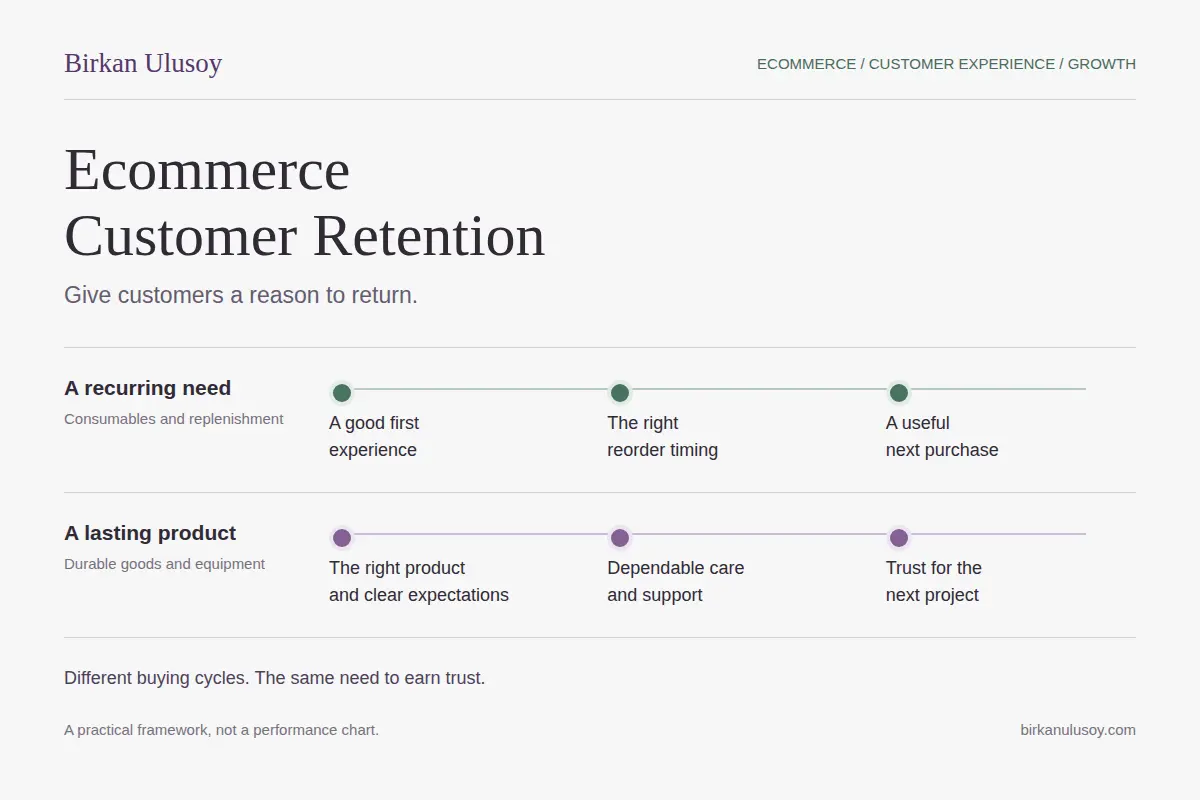
Before choosing a tactic, I would identify the next plausible customer need. Is the original product consumed, collected, replaced, expanded, repaired, or bought for someone else? The answer determines what a useful follow-up looks like.
| Business model | Reason to return | Useful action | Common mistake |
|---|---|---|---|
| Consumables | The product is running low | Reorder convenience and timing based on actual consumption | Sending the same reminder regardless of quantity purchased |
| Fashion and collections | A relevant new style, season, or occasion | Recommendations informed by preferences and prior purchases | Treating every customer as interested in every collection |
| Durable household products | A complementary need, another room, or eventual replacement | Care guidance, useful accessories, and dependable service | Calling a satisfied owner inactive too soon |
| B2B equipment | Expansion, another location, replacement, or a different equipment need | Account continuity, specification help, and relevant follow-up | Using frequent DTC replenishment messaging |
| Subscriptions | Ongoing product value at a suitable cadence | Flexible quantities, clear billing, and easy self-service | Mistaking cancellation friction for loyalty |
A store can contain several of these models at once. A coffee merchant may sell beans and expensive grinders. The beans can run out; the grinder should not. Segmenting only at the store level hides that difference.
I would examine first-purchase category, order quantity, acquisition source, and subsequent purchases before declaring someone overdue. The median interval among repeat purchasers can inform timing, but it excludes everyone who has not returned. It is not proof that the whole customer base should purchase on that schedule.
Seven customer retention strategies I would prioritize
1. Acquire customers whose needs the business can actually satisfy
Retention starts before checkout. An advertisement can attract a sale by exaggerating speed, quality, or suitability, but the customer eventually encounters the real product. The marketing team may record a conversion while the support team inherits an expectation the business cannot meet.
I would compare acquisition cohorts on returns, repeat behavior, and contribution, not just first-order acquisition cost. A campaign attracting bargain-only shoppers may look efficient on day one and weak after 90 days. A higher-cost campaign might attract a better-fit audience. That is a hypothesis to test, not an excuse to ignore acquisition costs.
Useful ecommerce content marketing helps set those expectations: explain fit, trade-offs, installation, compatibility, and who should choose a different product. Preventing a poor-fit purchase can be better than celebrating a conversion that becomes a refund.
2. Make the first purchase predictable
I would review the information people receive before and after paying. Does the delivery promise match fulfillment capacity? Are additional charges clear? Can the buyer understand returns, warranty boundaries, and whom to contact?
Baymard’s usability research documents the importance of making shipping and return information easy to find before purchase. That is evidence about buying friction, not a measured retention lift. My retention implication is that a business should not begin the relationship with avoidable surprises. Read Baymard’s research on shipping and return links.
Illustrative equipment example: a buyer may interpret freight delivery as installation. If those services are separate, explain that before payment and repeat the relevant preparation instructions before delivery. A persuasive product page should create an accurate expectation, not merely an optimistic one.
3. Help the customer succeed with the product
Post-purchase communication should answer what happens next. For a product requiring setup, send the correct instructions. For a product requiring care, make the relevant guidance easy to find. For a straightforward refill, make reordering convenient rather than overcomplicating the experience.
Use fulfillment events where possible. An order-date timer can send a review request before a delayed package arrives. Product guidance delivered at the wrong moment can become another reminder that the business has not noticed the problem.
I would begin with recurring support questions and return reasons. If people repeatedly misunderstand the same feature, improve the product information and onboarding. Do not solve the same preventable confusion one support ticket at a time forever.
4. Recommend the next useful purchase, not the highest-margin distraction
A recommendation should be explainable. It may complement what the customer owns, replace something consumed, or meet a preference the customer has chosen to share. Purchasing one product is not permission to assume everything about someone’s life.
Illustrative example: someone buying a grinder may appreciate compatible cleaning supplies. Another grinder two weeks later probably makes less sense unless they are buying for another location. Product compatibility and use case matter more than a generic bestseller block.
Recommendation rules need exclusions: already purchased, returned, unavailable, incompatible, or inappropriate while a complaint is unresolved. Better personalization sometimes means choosing not to send anything.
5. Resolve problems before asking for another order
I would connect customer service and marketing so that an unresolved delivery, damage, or refund issue can suppress inappropriate promotions. A cheerful sales message arriving during a difficult claim may make the disconnect feel worse.
A practical recovery process needs an owner, a clear next update, and an explanation the customer can act on. After resolution, ask whether the outcome actually addressed the problem. Do not assume that a closed ticket means a satisfied customer, or that recovering from a failure is better than avoiding the failure.
Measure repeat contacts, time to resolution, and subsequent behavior alongside satisfaction feedback. These are diagnostic signals; none alone proves that support caused a future purchase.
6. Make repeat buying convenient and voluntary
Useful account features can include accurate order history, saved specifications, compatible reordering, invoices, and clear subscription controls. The value is the work the customer no longer has to repeat.
A subscription should match a recurring need. Too much product, the wrong delivery interval, or unclear billing can undermine that relationship. I would make changing, skipping, and cancelling straightforward rather than use obstacles to preserve a dashboard number.
For B2B, convenience may mean remembering an approved model or providing an accurate quote for a second location. The most useful retention feature may be a reliable account history, not a points balance.
7. Use rewards and win-back offers selectively
A loyalty program can make a good relationship more rewarding. It cannot repair a product that disappoints or a support process customers avoid. First identify the behavior you want to encourage and the cost of the benefit.
Priority access, relevant education, useful service, or an easier purchase process may matter more than a discount. When an incentive is appropriate, check whether it creates additional contribution or simply reduces the margin on orders that would have happened anyway.
For win-back, distinguish someone whose usual purchasing interval has passed from someone who has no current need. Investigate the reason for inactivity before choosing an offer. Respect consent and suppression preferences; purchasing once is not a blank cheque for unlimited marketing.
Five real ecommerce customer retention examples
These examples serve different purposes. The first three are vendor-published customer stories with reported performance figures. The last two demonstrate observable service or product-design choices without a verified retention uplift. I would learn from the mechanism in each example, not turn every headline into a promised result.
Grind: use the consumption cycle to make reminders relevant
In Klaviyo’s historical Grind case study, the coffee brand estimated how long a tin of 30 pods would last and used that timing for replenishment messages. The report attributes 19% of automated-flow revenue to this replenishment flow and reports an average conversion rate of 4.4%.
The relevant change was a reminder connected to likely product need rather than a random send. However, those figures are platform-reported: 19% refers to flow revenue, not total company revenue, and the page does not give enough detail to reconstruct a controlled incremental lift.
What I would apply: build an initial timing hypothesis from product usage and quantity, then allow for differences between customers. A household buying three tins does not necessarily need the same reminder as someone buying one.
Heist Studios: recognize what the customer already likes
Klaviyo’s Heist Studios story describes giving previous purchasers early access to new colors and styles within categories they had bought. The page reports a 50% increase in repeat purchase rate associated with personalization and an 11% increase in average order value from a first purchase to a second.
I would not read that as a universal effect of personalization. The published account does not provide a complete repeat-rate denominator, comparison window, and experimental design. The average-order-value comparison also concerns customers who progressed to a second purchase, not every acquired customer.
What I would apply: use established category interest to make new-product communication more useful. Offer a relevant next choice rather than assume the customer wants the entire catalog.
Half Magic: connect the customer experience across systems
The Half Magic case study describes work with Lilo Social to consolidate messaging and personalize account experiences. Klaviyo reports fivefold year-over-year growth in the number of repeat purchasers and 110% growth in automation revenue over the stated 12-month comparison.
The crucial wording is number of repeat purchasers. Five times as many repeat buyers is not necessarily a fivefold increase in retention rate. If the acquisition base grew substantially, the count could rise without a comparable improvement in the probability of returning. The story also describes several changes, so it does not isolate one feature’s causal effect.
What I would apply: align order, preference, and messaging data so that the business recognizes the same customer across relevant touchpoints. Buying a larger technology stack is not itself a retention strategy.
Patagonia: support the product the customer already owns
Patagonia’s Worn Wear program provides repair resources and routes for keeping products in use. Its official materials include care and repair guidance as well as options related to used gear.
This is not a quantified retention experiment. It demonstrates that an ongoing relationship can include helping a customer keep a durable product rather than repeatedly urging replacement. Whether a particular repair interaction increases later purchases requires separate evidence.
What I would apply: make care instructions, appropriate repair support, and warranty information accessible for long-lived products. A customer who does not need another unit today can still have good reasons to remember the seller when a different need appears.
Chewy: make recurring deliveries adjustable
Chewy Canada’s official Autoship information describes scheduled repeat deliveries with options to update, skip, or cancel. Its help materials explain changing frequency and the next order date.
Those controls demonstrate flexibility in a recurring-purchase experience. They do not, by themselves, establish a retention increase. I am referring specifically to the Canadian service documentation; terms and availability can differ by market.
What I would apply: treat changing consumption as normal. A convenient recurring order should remain convenient when the customer’s needs change. Measure successful renewals, skips, cancellations, and complaints separately instead of treating every paused shipment as a failure.
How to measure ecommerce customer retention
The word retention is used for several different calculations. Before comparing two numbers, write down the customer group, qualifying order definition, observation period, and denominator. A dashboard label is not enough.
1. Cohort second-purchase rate
For a practical first-to-second-order measure, I would group customers by when they first purchased and give each customer the same observation window.
90-day second-purchase rate
Customers with a qualifying second order within 90 days of their first / Customers in the first-purchase cohort with a full 90 days of follow-up × 100
Decide how to handle test orders, cancellations, replacements, and refunds before calculating the metric. A free replacement should not masquerade as an additional commercial purchase. Keep the customer in the original acquisition cohort where appropriate even if their first order is later refunded; excluding disappointed buyers after the fact can flatter the result.
This cumulative measure differs from the share of a cohort that orders in one particular month. Shopify’s analytics reference defines cohort retention for a given period in terms of customers in that cohort who placed an order in that period. Do not add monthly percentages together: one customer can appear in several months.
2. Returning-customer share and returning-customer revenue
A store-wide returning-customer share tells you about the mix of people purchasing during a period. Specify whether returning means they had an order before the period began or made a repeat order during it, and how customers with both a first and second order are counted.
Returning-customer revenue share is a different measure: revenue assigned to returning-customer orders divided by total revenue under the same accounting definition. Neither is interchangeable with the percentage of an acquisition cohort that returns.
Illustrative warning: suppose returning-customer revenue remains $40,000 while new-customer revenue falls from $60,000 to $20,000. The returning share rises from 40% to about 66.7%, even though returning revenue did not grow and total revenue fell. That is not a retention victory.
3. Time to the second purchase
Track the number of days between a customer’s first and second qualifying orders. Report the observation window and whether you are describing only people who returned. A short median among a small group of repeat buyers can coexist with a low overall repeat rate.
For a basic operating dashboard, I would pair the timing distribution with cumulative second-purchase rates at relevant horizons. For more rigorous analysis, customers who have not returned by the reporting cutoff need to remain in the analysis rather than disappear from it.
4. Observed contribution per acquired customer
I would prefer an observed 90-, 180-, or 365-day contribution measure to an optimistic lifetime-value prediction with unclear assumptions.
Observed cohort contribution per customer
(Net revenue minus defined variable costs over the horizon) / Original acquired customers in the cohort
Define variable costs consistently: product cost, payment fees, fulfillment and shipping subsidies, relevant return costs, and attributable variable service costs. Do not subtract discounts twice if they are already reflected in net revenue. This contribution measure is not net profit because fixed overhead is not necessarily included.
To assess acquisition payback, compare cumulative contribution before acquisition cost with acquisition cost on a consistent basis. Label any forecast separately from observed results. A 90-day value is not a customer’s full lifetime value.
5. Subscription and service indicators
For subscriptions, define the starting active customer group and distinguish voluntary cancellation, failed-payment loss, pauses, and reactivation. If reporting customer retention, track customers, not a mixture of customers and individual subscriptions.
The familiar (ending customers - new customers) / starting customers formula is useful only with consistent active-customer definitions and treatment of reactivation. For non-subscription retail, an all-time customer database is not an active subscriber base. Its size alone cannot tell you who has been retained.
Track complaints, refunds, repeat support contacts, and unsubscribes as guardrails. They help reveal harm that a revenue total can hide, but they are not substitutes for a purchasing or paid-retention outcome.
A worked example: more repeat buyers, weaker retention
Imagine two first-purchase cohorts. These are illustrative numbers, not results from Atlantic or another client. Every customer in both groups has completed the same 90-day follow-up period.
| Measure | Cohort A | Cohort B |
|---|---|---|
| Acquired customers | 1,000 | 2,000 |
| Customers making a second purchase within 90 days | 250 | 400 |
| 90-day second-purchase rate | 25% | 20% |
| Repeat-buyer count change versus A | Baseline | +60% |
| Second-purchase rate change versus A | Baseline | -5 percentage points |
The store has 60% more repeat buyers in Cohort B, but a lower proportion of acquired customers returned. That does not prove the business is worse: total contribution could still be higher. It does mean that the claim “retention improved by 60%” would be misleading.
I would then split the cohorts by first product, acquisition channel, discount exposure, and fulfillment experience. A change in customer mix can explain an aggregate change. Do not compare a fully matured cohort with customers who joined last week, or interpret a seasonal difference as an experimental result.
In Shopify, the customer cohort analysis report groups customers around their first orders and offers views of subsequent activity. Use its documented period definitions; a calendar-month cohort cell is not automatically the exact customer-level 90-day calculation above.
Test whether the strategy creates additional value
If a customer receives an email and buys afterward, the email may deserve some credit. But the sequence of events does not establish that the order would otherwise have been lost. Retention marketing often reaches people who already have a reason to buy.
Where volume and tooling allow, I would randomly assign eligible customers to a treatment and a comparison group before the intervention. Keep the definition of eligible customers fixed, observe the same period, and measure total qualifying purchases rather than only orders attributed to the message.
Klaviyo’s global holdout documentation describes this distinction at a program level, but that feature has eligibility requirements. It is not an assumption that every small store can switch it on. A narrower experiment may be more practical.
An illustrative profit-aware test
Suppose two randomized groups contain 1,000 eligible customers each. Over the same window, 120 customers in the treatment group make one repeat order each, compared with 100 in the control. The observed difference is two percentage points: 12% versus 10%. It is also a 20% relative increase, before assessing statistical uncertainty.
Now suppose each order contributes $30 before the test incentive, and every treatment buyer receives a $10 incentive. Treatment contribution is $2,400: 120 × ($30 – $10). Control contribution is $3,000: 100 × $30. More people purchased, but the observed contribution is $600 lower in the treatment group before additional program costs.
The simplified example ignores future effects and assumes identical pre-incentive economics. It is not proof that incentives fail. It shows why an experiment should measure both behavior and economics, with sufficient follow-up for the intended decision.
Before running a test, specify the primary metric, minimum worthwhile improvement, sample requirements, duration, and stop rules for harm. Do not declare victory after the first good day. Keep order confirmations, essential service updates, and safety information outside promotional holdouts.
How I would approach retention for B2B equipment and durable products
My work at Atlantic makes this distinction especially relevant. The business sells products that other suppliers also carry, and manufacturer MAP policies constrain advertised-price competition on applicable products. I cannot treat an endless sequence of larger advertised discounts as the entire marketing strategy.
Instead, I would build the relationship around reducing the buyer’s work and uncertainty. Did we help them choose the right unit? Were specifications clear? Did they understand delivery requirements? Can we find the previous order when they need another piece of equipment?
The following is a proposed operating model, not a claim that these steps have already generated a measured retention lift at Atlantic:
- Before purchase: capture the relevant requirements and confirm product fit, availability, and service boundaries.
- Before delivery: provide accurate preparation information and a clear contact for questions.
- After delivery: make model-specific documentation, warranty routes, and the appropriate support channel accessible. Do not invent maintenance advice; use the manufacturer’s instructions.
- During ownership: follow up only when there is a credible reason, such as a requested resource or a compatible need. Resolve outstanding issues before promoting more products.
- At the next project: use the account history to make quoting and selection easier, without assuming that every location has identical requirements.
Measure repeat purchasing over a horizon appropriate to the category. Supplement it with qualified repeat inquiries, quote outcomes, and separately identified referrals. At the account level, distinguish multiple contacts from multiple customers and document how locations roll up to the same business.
I would also distinguish unavailable opportunity from lost opportunity. A business that has no need for more equipment is different from one that buys its next unit elsewhere because the first experience was poor. The difference may require a conversation, not another automated segment.
This is the retention side of Same Product Better People. The product may be the same. The quality of the relationship, information, and follow-through does not have to be.
A practical 90-day customer retention plan
Ninety days is a useful implementation period, not a promise that every product category will produce a mature retention result in that time.
Days 1-30: define the problem and establish the baseline
Document qualifying orders and customer identity rules. Build mature first-purchase cohorts. Separate relevant product categories and look at returns, service issues, second-order behavior, and contribution. Read customer feedback and speak with support staff about recurring friction.
Choose one problem with a plausible connection to the next purchase. “Improve retention” is too broad. “First-time buyers cannot find setup guidance and repeatedly contact support” is specific enough to investigate.
Days 31-60: fix one experience and launch one test
Assign an owner across marketing and the relevant operational team. Update the information, journey, or self-service capability. Check timing, consent, suppression, product availability, and compatibility. Use a comparison group where feasible and document concurrent changes.
For communication design, my ecommerce email marketing guide provides expert examples and flow-planning lessons. Here, the priority is the customer outcome those messages support, not the number of messages launched.
Days 61-90: evaluate and decide what happens next
Review the primary outcome and the guardrails. Check whether the observation window is mature and whether the sample is informative. Continue observing if necessary; an inconclusive result is not a failed analysis.
Keep, revise, or stop the intervention based on the evidence. Preserve the original hypothesis, eligibility criteria, test dates, economic assumptions, and lessons so the next team member can understand the decision.
The one-page brief I would use
- Customer group: who qualifies, and who should be excluded?
- Customer problem: what makes the next useful action difficult?
- Evidence: which order data, support themes, or research supports the diagnosis?
- Proposed change: what will be different for the customer?
- Primary outcome: what will count as success, with which denominator and horizon?
- Guardrails: what must not worsen, including margin, complaints, and refunds?
- Comparison: how will we distinguish the change from normal behavior?
- Owner and review date: who makes the decision, and when will enough evidence exist?
Start with the order platform, a dependable way to connect support context, and the tools needed for the chosen intervention. An additional retention app is justified when it solves a defined limitation, not because its dashboard makes the strategy look more sophisticated.
Frequently asked questions
What is a good ecommerce customer retention rate?
There is no useful universal number without a category, customer group, observation window, and metric definition. A refill business and an equipment supplier have different opportunities. Compare mature, similar cohorts within your own business first, then use relevant external benchmarks as context rather than targets to copy.
What is the difference between retention rate and repeat purchase rate?
Definitions vary. A cohort-period retention rate may count customers who buy in a particular interval. A cumulative second-purchase rate counts customers who have made a second purchase by a defined deadline. Both can be useful, but the same person may appear in several period-based measurements. Write out the calculation rather than relying on the name.
Can customer retention improve without discounts?
Yes, a strategy can focus on better product fit, fulfillment, support, care guidance, relevant recommendations, or easier reordering. Whether those changes improve your measured outcomes must be evaluated. Discounts are one possible tactic, not the definition of retention.
Should a small store launch a loyalty program first?
I would first check product satisfaction, delivery expectations, support, and the natural reason to buy again. A simple improvement to the first experience may deserve priority over a points system. Introduce rewards when the benefit, intended behavior, operational cost, and measurement plan are clear.
How do you retain customers who buy a product only once?
You cannot create a legitimate replacement need just to improve purchase frequency. Support the product, remain useful, and be ready for relevant complementary purchases or future projects. Track referrals and service engagement separately. If the category offers little repeat opportunity, acquisition economics must work without an imaginary stream of future orders.
Is email marketing the same as retention marketing?
No. Email is a communication channel. Retention also depends on acquisition fit, product quality, fulfillment, support, pricing, and the ease of doing business again. A message can remind someone of a useful next step; it cannot make an unresolved service problem disappear.
How often should a retention strategy be reviewed?
Monitor operational harm promptly, review cohort and contribution trends at intervals suited to the buying cycle, and assess experiments after their planned observation period. Review the strategy when the product mix, acquisition mix, fulfillment model, or customer needs change. A weekly dashboard check should not force a weekly strategic reversal.
Give the customer a reason to choose you again
I do not think the strongest retention strategy begins with “How can we get another order?” It begins with “What did the first purchase teach the customer about us?”
If the answer is that the product fit, the information was accurate, the delivery was predictable, and help was available when needed, the next conversation starts from a better place. If the answer is disappointment, more reminders may only repeat the problem.
For an ecommerce business, retention is not a separate layer of marketing added after the sale. It is the commercial consequence we hope to earn by being worth choosing again, measured honestly over a timescale that fits the customer.
Research reviewed September 2026. Case-study results describe their original reporting periods, not current brand performance. This guide should be revisited when linked evidence, analytics definitions, or platform capabilities change; illustrative examples remain explicitly separate from observed client results.
Building the foundations first? My 60-step ecommerce launch checklist connects business email, product information, checkout, measurement, and your first marketing campaigns.